






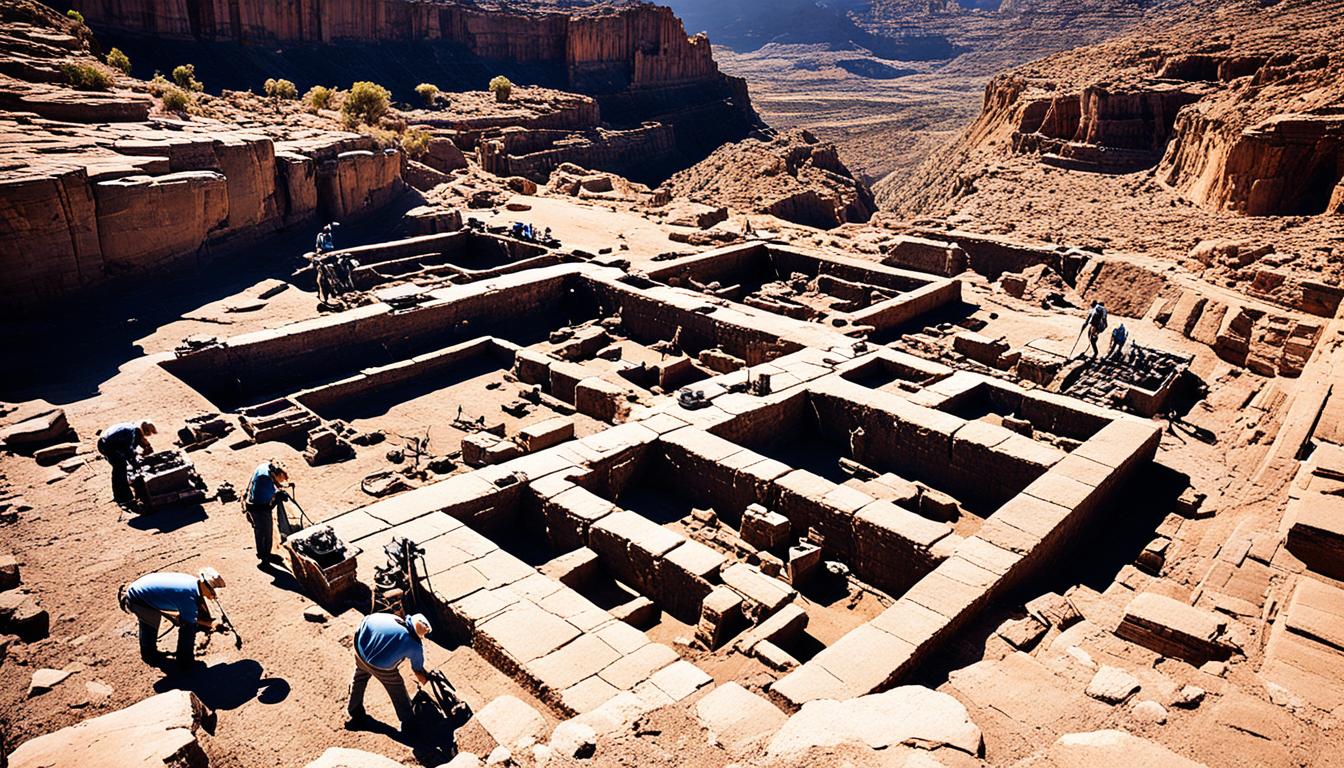
Archaeology is a thrilling field that uncovers the secrets of old civilizations. It sheds light on our shared past. From reading ancient scripts to finding legendary cities, these discoveries amaze scholars and the public. This article will look at the top archaeological finds that changed how we see ancient history and the cultures before us.
Archaeology studies human life through artifacts and cultural remains. By digging and using new tools, archaeologists have found a lot of information. This has changed our view of human history. Discoveries like the Rosetta Stone and Tutankhamun’s tomb have shown us what our ancestors were like, leaving us amazed.
Let’s explore the amazing stories of some top archaeological discoveries. Get ready to go back in time and learn the secrets of the past. These discoveries still shape our view of today and tomorrow.
The Rosetta Stone: Unlocking the Secrets of Ancient Egypt
The Rosetta Stone is a key find that changed how we see ancient Egypt. Found in 1799, it helped unlock the secrets of ancient hieroglyphs. The stone has texts in Greek, demotic, and hieroglyphic scripts. This made it possible to understand ancient Egyptian language.
The Breakthrough That Deciphered Hieroglyphs
For a long time, the hieroglyphs in ancient Egyptian temples and tombs were a mystery. The Rosetta Stone changed that. By comparing texts in Greek, demotic, and hieroglyphic, scholars could finally read the hieroglyphs. This breakthrough opened up a new world of knowledge.
Exploring the Fascinating History Behind This Iconic Artifact
The story of the Rosetta Stone is as interesting as its discovery. French soldiers found it during Napoleon’s Egyptian campaign. Its ownership and location have caused debates and diplomatic issues. Now, it’s at the British Museum, where it amazes people from all over, showing the impact of archaeological discoveries.
Tutankhamun’s Tomb: A Timeless Treasure Trove
In 1922, the discovery of Tutankhamun’s tomb was a major archaeological find. British archaeologist Howard Carter and his team found the tomb almost untouched. They were amazed by the wealth of artifacts inside.
This find showed us the luxurious life of ancient Egyptian royalty. It shed light on their beliefs and practices.
Tutankhamun, or the “boy king,” ruled Egypt about 3,300 years ago. His short reign has fascinated people all over the world. His tomb was a treasure trove, full of gold jewelry, furniture, and his mummified body.
The artifacts from Tutankhamun’s tomb changed how we see ancient Egyptian culture. They include a beautiful sarcophagus, ornate chariots, and ceremonial objects. Each item shows the luxury of the pharaohs.
These finds have given us new insights into mummification, religious beliefs, and ancient Egypt’s politics during Tutankhamun’s time.
Tutankhamun’s tomb still fascinates scholars, historians, and the public. The artifacts from this site are symbols of ancient Egypt. They have shaped our understanding of this ancient civilization.
Machu Picchu: The Lost City of the Incas
In 1911, American explorer Hiram Bingham found Machu Picchu. This amazing Inca citadel was hidden in the Andes Mountains of Peru. It had been lost for centuries.
Exploring Machu Picchu has shown us the advanced engineering and construction skills of the Inca Empire. It also revealed the complex social and religious life of this ancient culture.
Unraveling the Mysteries of This Legendary Citadel
Machu Picchu is known as the “lost city of the Incas.” It draws visitors from all over the world. This Inca stronghold sits on a mountain ridge, showing the Inca’s amazing building skills.
Scholars have wondered about Machu Picchu’s purpose. Some think it was a royal retreat, others believe it was a sacred place.
Exploring the Advanced Engineering Feats of the Incas
The building of Machu Picchu shows the Incas’ incredible engineering skills. It has perfectly cut stone blocks, farming terraces, and a complex water system. The Incas were experts in stonework and building on tough terrain.
Visiting Machu Picchu lets us see the amazing engineering of the Incas. It shows us the creativity and achievements of this ancient civilization.
Pompeii: A Frozen Moment in Ancient Roman Life
The ancient Roman city of Pompeii is a powerful reminder of nature’s strength and human resilience. In 79 AD, Mount Vesuvius erupted, covering Pompeii in ash and pumice. This disaster buried the city, but it also preserved it in time.
This preservation has given archaeologists a unique look into the lives of ancient Romans. They found a city full of life, with people from all walks of life. Artisans, merchants, and aristocrats lived together, creating a vibrant community.
Excavations have shown us what life was like in Pompeii. We see well-preserved buildings, artifacts, and even the people who lived there. The city’s walls once had beautiful frescoes, and its markets were full of life.
Uncovering the Tragic Tale of a City Buried in Ash
Archaeologists have uncovered the tragic story of Pompeii’s people. They found human remains, showing how the eruption caught everyone off guard. These finds help us understand the last moments of Pompeii’s residents.
Pompeii is a treasure for archaeologists, offering a close look at ancient Roman life. It teaches us about the Roman civilization and the forces of nature that shaped its fate.

Amazing Discoveries at the Terracotta Warriors
In 1974, the Terracotta Warriors were found, and it was a big deal. This huge army of clay figures was made to protect the tomb of China’s first Emperor, Qin Shi Huang. Their size and detail show the military, political, and artistic skills of the Qin Dynasty.
Marveling at the Life-Size Army Guarding an Emperor’s Tomb
The Terracotta Warriors show ancient China’s grandeur and power. Each soldier has its own look and is set up in a specific way, as if waiting to defend their emperor. They were found near Xi’an, near the tomb of Qin Shi Huang, which is a huge achievement in engineering and art.
Archaeologists have been carefully digging up and studying the Terracotta Warriors. They find new things that help us understand ancient China better. The details on the figures, like their clothes and weapons, are amazing. This find has caught the public’s attention and helped scholars learn more about ancient China.
The Terracotta Warriors show the lasting impact of the Qin Dynasty and ancient Chinese creativity. As archaeologists keep digging, we look forward to more discoveries about this fascinating army. They protect the tomb of China’s first Emperor, and their story is still being uncovered.
Göbekli Tepe: The World’s Oldest Temple
In southeastern Turkey, a site has changed what we know about human history. Göbekli Tepe is over 11,000 years old, making it the oldest known temple. It shows us that organized religion and complex societies started earlier than we thought.
Rewriting the History of Human Civilization
The find at Göbekli Tepe has shocked archaeologists. The site has stone pillars up to 20 feet tall and detailed artwork. This shows early humans in the Neolithic period were more advanced than we thought.
Before, we thought organized religion and big societies came later. But Göbekli Tepe shows they started much earlier. This has changed our view of human history by thousands of years.

Göbekli Tepe is huge, with massive pillars arranged in complex ways. This shows an organized society that could do big projects. This discovery has changed how we see the Neolithic period and the evolution of humans.
The Dead Sea Scrolls: Ancient Texts, Modern Revelations
The discovery of the Dead Sea Scrolls in the 1940s changed archaeology and biblical studies. These ancient texts were found in caves near the Dead Sea. They include early copies of biblical texts and other religious and historical documents.
The Dead Sea Scrolls are over 900 ancient texts. They include fragments of the Hebrew Bible and unknown works. Bedouin shepherds found them in caves near the Dead Sea. Scholars have studied them intensely since then.
The scrolls help us understand how religious texts evolved. They show the early development of Judaism and Christianity. They contain early versions of biblical books like the Book of Isaiah.
These scrolls also have other religious and historical documents. There are community rules, hymns, and apocalyptic writings. They give us insights into Jewish sects and communities during the Second Temple period.
The Dead Sea Scrolls have greatly changed how we see the ancient world and Abrahamic religions. Scholars are still studying them, making new discoveries. This keeps our knowledge of this important archaeological find growing.
Stonehenge: Unraveling the Enigma of the Standing Stones
The Stonehenge, a famous prehistoric monument in Wiltshire, England, has fascinated people for centuries. It’s a place where many theories about its purpose and importance have been shared. People have wondered about its role in history.
Some think it was an astronomical calendar. Others believe it was a spot for ancient rituals and ceremonies. The mystery of Stonehenge has grown over time. New studies and findings have brought more light to this prehistoric monument. This has made researchers and visitors even more curious.
Exploring Theories Behind This Prehistoric Monument
Many theories have been put forward to explain Stonehenge. Each theory offers a different view of this mysterious site. Was it a place to watch the stars, a spot for people to come together, or a site for complex ancient rituals? The real purpose of Stonehenge is still a mystery, waiting for more research and understanding.