






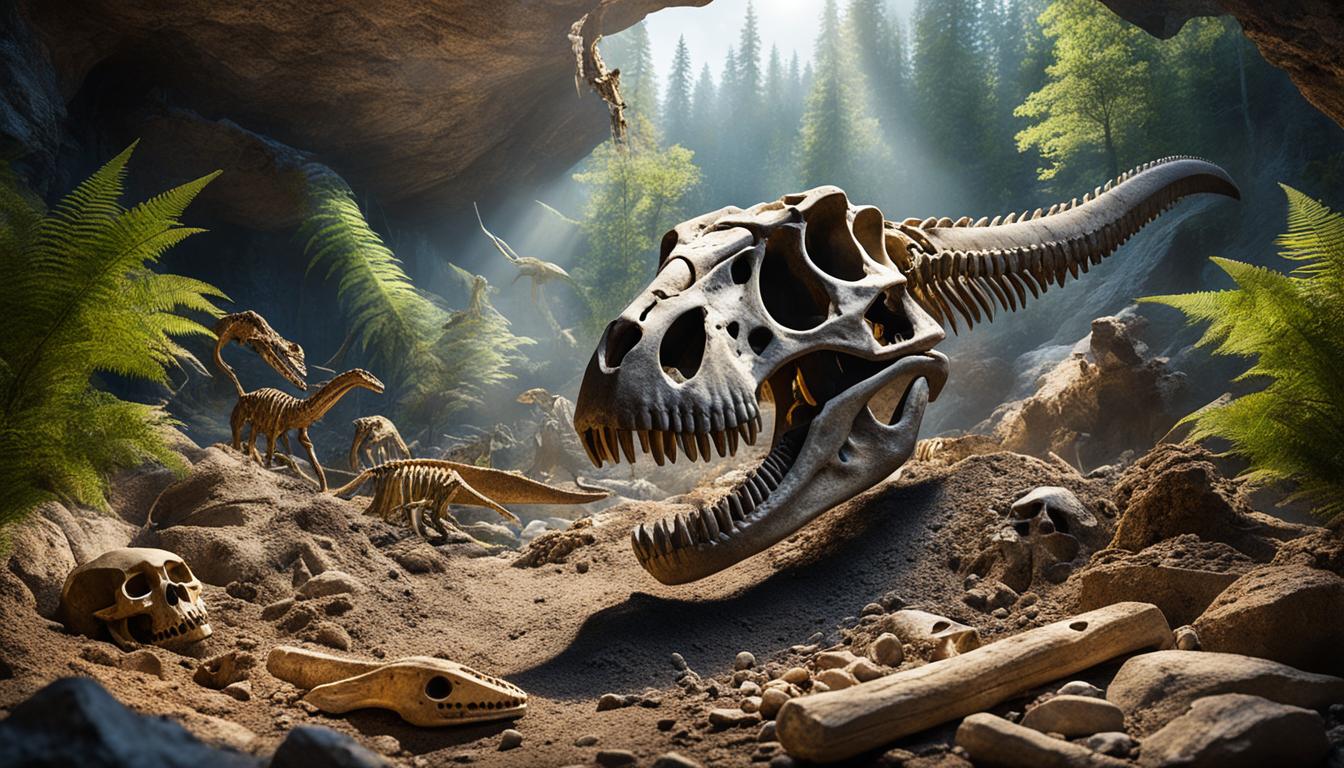
Paleontology has seen some amazing discoveries that changed how we see prehistoric life. These findings include the huge fossils of dinosaurs and the beginnings of human evolution. This article will look at the most important fossil discoveries that have changed science and our knowledge of the past.
Over millions of years, Earth has seen many species come and go, leaving behind fossils. Paleontologists have found a lot about the different life forms that once lived here. They’ve found everything from the big Tyrannosaurus rex to the mysterious Archaeopteryx, a mix of dinosaur and bird.
These discoveries have amazed people and changed how we think about evolution and the natural world. They show us the incredible variety of life that once was.
Uncovering Ancient Giants: Dinosaur Fossils
The discovery of massive dinosaur fossils has amazed the world. It has changed how we see these ancient giants. Paleontologists have found many dinosaur fossils. These discoveries reveal secrets of famous dinosaurs like the Tyrannosaurus Rex and the Triceratops.
Iconic Finds: Tyrannosaurus Rex and Triceratops
Finding Tyrannosaurus Rex fossils changed paleontology. These fierce predators had huge jaws and sharp teeth. They caught the public’s attention and sparked debates on their hunting ways and rule in the ancient world.
The Triceratops fossils also showed how these plant-eaters were well-adapted. They had big horns and a bony frill for defense against top predators.
Exploring Mass Extinctions and Evolution
Researchers have found evidence of mass extinctions with dinosaur fossils. The Cretaceous-Paleogene extinction, which killed the dinosaurs, helps us understand evolution. By studying these fossils, scientists learn about the evolution of life on Earth.
This shows how life has changed over time. It highlights life’s resilience and adaptability on our changing planet.
Tracing Our Origins: Human Evolution
Paleontologists have made big steps in understanding human evolution. The “Lucy” fossil is a key find that has given us a lot of insight into our past. By looking at these old human fossils, scientists have pieced together the story of how we evolved from our ancient ancestors.
Lucy: A Remarkable Fossil Discovery
The Lucy fossil was found in Ethiopia in 1974 and changed how we see human evolution. It’s a well-preserved skeleton from about 3.2 million years ago. Lucy shows us what early humans looked like and how they lived, changing our view of human history.
Lucy’s fossil tells us that early humans could walk on two legs, a key human trait. It also shows us what their brains and bodies were like. These details help us understand how our ancestors lived and how we became Homo sapiens.
The Lucy fossil shows how important paleontology is in learning about our human history. By studying these fossils, scientists keep uncovering the story of our evolution. They reveal the amazing changes and adaptations that made us who we are today.
Amazing Discoveries from Ancient Oceans
The ancient oceans have been full of surprises for scientists. They’ve found fossils of huge marine reptiles and the massive teeth of the Megalodon shark. These finds give us a peek into the lives of powerful sea creatures from long ago.
Prehistoric Marine Reptiles and Megalodon
Scientists have found fossils of ancient marine reptiles like ichthyosaurs and plesiosaurs. These creatures had sleek bodies and big jaws. They were top predators, hunting in the deep ocean.
They also found the huge teeth of the Megalodon shark. This shark lived during the Miocene epoch and had teeth as big as a human hand. It was the biggest fish predator ever, eating whales and big sea mammals.

These discoveries from the ancient oceans have taught us a lot about the past. By studying these fossils, scientists learn about the evolution of sea life. They help us understand the history of our oceans.
Unlocking Secrets of Prehistoric Mammals
Paleontologists have made amazing discoveries with prehistoric mammal fossils. These finds have shown us how our mammal ancestors lived with dinosaurs millions of years ago. They’ve also revealed the incredible ways these creatures adapted and evolved.
One key discovery was finding fossils of many different prehistoric mammals. These fossils have given us deep insights into how mammals evolved. They show how small, early mammals turned into the diverse group we see today, from giant woolly mammoths to fierce saber-toothed tigers.
By looking at these fossils, scientists can follow the evolutionary paths of mammals. This helps us understand how they adapted to new environments and roles over millions of years. It also gives us hints about the future of mammals, including us.
As we keep finding more fossils, we’ll learn more about our mammal ancestors. This will tell the amazing story of how they evolved and adapted to their changing world.
Fossils that Challenged Scientific Theories
Throughout history, some fossils have changed what scientists thought they knew. The discovery of Archaeopteryx is a prime example. It’s seen as the “missing link” between dinosaurs and birds.
Archaeopteryx was found in Germany in the 1800s. It had features of both dinosaurs and birds. It had feathers for wings but also had dinosaur-like teeth and a tail. This mix of traits challenged the old idea that birds came from non-avian dinosaurs.
Archaeopteryx: The Missing Link
The find of Archaeopteryx changed how scientists thought about evolution. It was proof of how dinosaurs turned into birds. Before, the link between them was just a theory.
Archaeopteryx’s discovery made scientists rethink their views on evolution. It led them to look deeper into fossils for more clues. Today, studying fossils like Archaeopteryx helps us understand how life has changed over time.
Prehistoric Plant Life: Unraveling Ancient Ecosystems
Paleontologists have looked into ancient plant life, not just dinosaurs. They’ve studied prehistoric plant fossils and petrified forests. This has given us a clearer picture of the ecosystems that were here millions of years ago.
Petrified Forests and Fossilized Flora
Petrified forests are a big find in paleobotany. These forests, stuck in time, tell us a lot about ancient plants. By looking at fossilized leaves and tree trunks, scientists can see what these old ecosystems were like.
Petrification turns organic matter into stone, saving many plant fossils. These fossils show us the variety of plants that once covered Earth. They range from huge ancient trees to tiny ferns and mosses. Scientists use these fossils to learn about the climates and environments of the past.

Studying ancient plant fossils helps us understand the past and modern plants too. It shows how plants have changed over time. This helps scientists learn about the reasons plants change and go extinct. It gives us a deeper look into the history of life on Earth.
Amazing Discoveries from Prehistoric Insects
Paleontologists have found many fascinating things about ancient insects from fossils. These fossils tell us about the evolution and variety of life on Earth. They help us understand how all living things are connected.
Studying these fossils shows us a world of ancient insects, from flying to crawling ones. They lived in different times and places. These fossils give us clues about their lives and how they fit into their environments.
One cool find is the fossils of giant dragonfly-like insects called griffinflies. They had wings up to 2.5 feet wide. This shows us what life was like when the air was full of oxygen, supporting huge insects.
Other fossils include those of ancient cockroaches, termites, and early spiders. Each one shows how these creatures changed and survived over time.
The study of these fossils still excites scientists and the public. It teaches us about the strange creatures that once lived here. It also makes us think about protecting our planet’s diversity for the future.
Exploring Ancient Environments Through Fossils
Fossils are like time capsules from the past. They tell us about ancient environments and climates. These preserved remains of life help us understand the Earth’s history.
Uncovering Past Climates and Landscapes
Paleontologists study fossils to learn about ancient times. They look at plants, animals, and tiny organisms. This helps them piece together what the Earth was like long ago.
For example, fossils of tropical plants and animals in cold places show that the climate was once different. Fossils of sea creatures far from the ocean tell us that the land was once near the sea.
By studying fossils, scientists learn about the Earth’s evolution. This knowledge helps us understand past environmental changes. It also helps us predict and deal with today’s climate changes.
Cutting-Edge Fossil Hunting Techniques
The world of paleontology has seen big changes in how fossils are found and studied. Now, researchers can uncover and study ancient wonders like never before. Thanks to advanced imaging and dating methods, these tools have changed the game. They let paleontologists learn more about the past than ever before.
Ground-penetrating radar is one key tool that has changed things. It helps scientists see what’s underground and find fossils without digging them up. With 3D modeling and high-resolution scanning, paleontologists can now document and preserve fossils with great care.
Another big step forward is in radiometric dating. This method lets researchers figure out how old fossils are with a lot of accuracy. By looking at how radioactive isotopes have decayed, they can piece together the timeline of evolution. This helps us understand how ancient species lived and interacted with their worlds.