






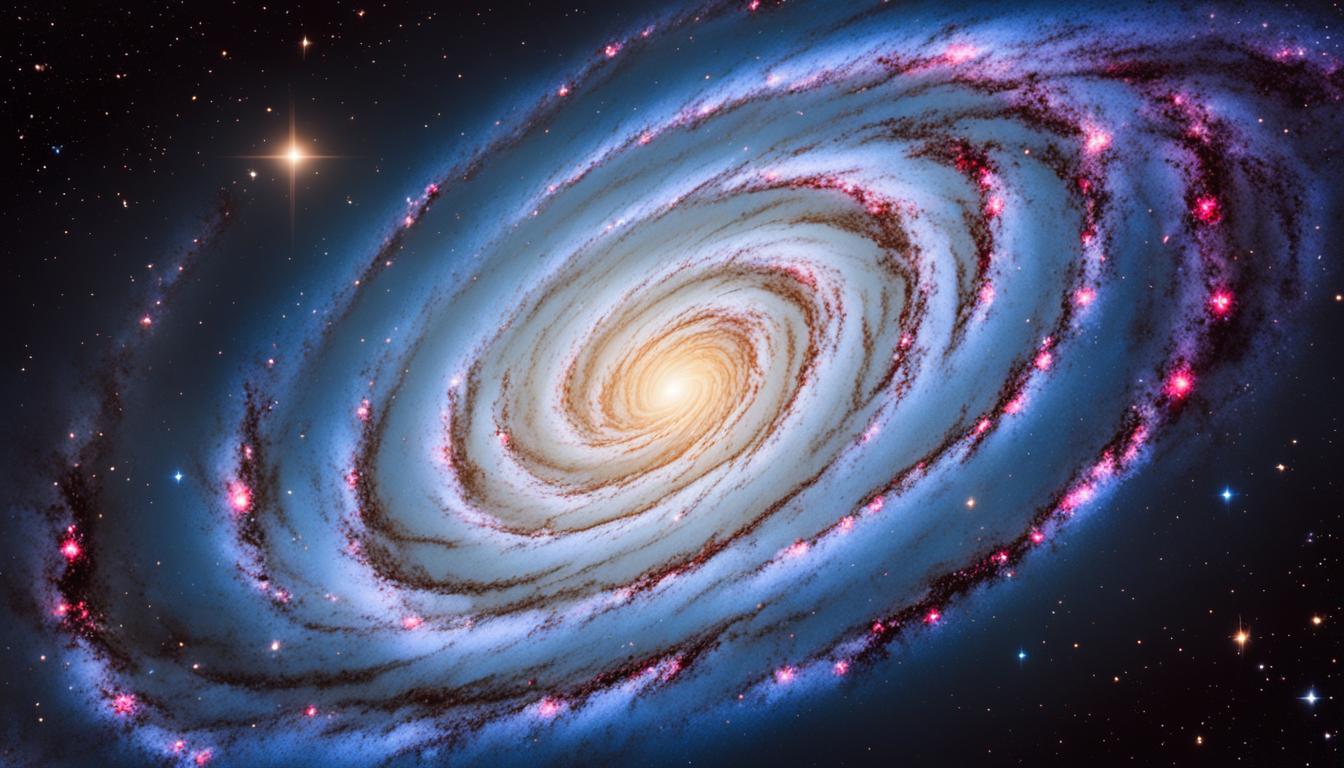
Start an exciting journey through the cosmos and find out the top scientific discoveries that changed how we see the universe. We’ll look into the mysteries of the Big Bang and the tiny world of subatomic physics. This article shares the amazing findings that have expanded our knowledge.
Get ready to be wowed as we check out the edges of cosmology, astronomy, and quantum mechanics. We’ll see the big ideas that changed how we see our world. Dive into the universe’s secrets, where incredible scientific discoveries are waiting. They reveal the basics of our existence.
Unraveling the Mysteries of the Big Bang
Scientists and philosophers have always been curious about the universe’s start. The Big Bang theory suggests our universe began with a huge event billions of years ago. Through new discoveries, we’ve learned a lot about the early universe.
Cosmic Microwave Background Radiation
The discovery of the Cosmic Microwave Background (CMB) radiation was a big step forward. This faint glow is the oldest light in the universe, dating back to 380,000 years after the Big Bang. The CMB supports the Big Bang theory by matching its predictions, giving us a peek into the early universe.
Expansion of the Universe
Understanding the universe’s expansion was another key finding. By watching galaxies move, scientists found the universe is getting bigger. This fits with the Big Bang theory, helping us grasp the universe’s beginnings and how it has changed over time.
The Big Bang still fascinates scientists as they explore its secrets. With ongoing research and new discoveries, we’re slowly uncovering the universe’s early mysteries. This helps us understand where we come from.
Amazing Discoveries in Astronomy
Astronomy has always fascinated humans. In recent years, it has seen amazing discoveries. These have changed how we see the universe. One big find is exoplanets – planets that orbit stars other than our Sun.
Exoplanets and Habitable Zones
Exoplanets have opened new doors in searching for life beyond Earth. Astronomers have found many exoplanets. Some are in the habitable zones of their stars, where water can exist and life might start.
This has made us hopeful about finding life elsewhere. We now know that planets like ours might exist elsewhere. The study of these zones helps us understand if a planet can support life.
This knowledge changes how we see our place in the universe. It shows us the universe is full of possibilities.
As we improve our tools, astronomy will make more amazing discoveries. The search for exoplanets and understanding their zones is exciting. It keeps scientists and the public eager to learn about life in space.
Unveiling the Secrets of Black Holes
In the vast universe, black holes are mysterious places where gravity pulls so hard, not even light can escape. These cosmic wonders intrigue scientists and the public, as they help us understand spacetime and the universe’s laws.
Albert Einstein first hinted at black holes with his theory of general relativity. His work showed that massive stars could collapse into these regions of intense gravity. Today, scientists have found lots of proof, like gravitational waves from LIGO and images of the Milky Way’s supermassive black hole.

Studying black holes has changed how we see gravity and spacetime. They show us strange things that challenge our old ideas, like singularities where physics stops making sense. Researchers are still learning about black holes, including their event horizons and how they interact with matter and energy.
Exploring black holes gives us new insights into the universe. This research has grown our knowledge of astrophysics and pushed us to think differently about gravity, spacetime, and our theories. The search for black hole secrets could lead to big discoveries that change how we see the cosmos.
Exploring the Frontiers of Quantum Mechanics
Quantum mechanics is a fascinating field that challenges our understanding of the world. It’s where the rules of the big world don’t apply anymore. At its core, we find quantum entanglement and superposition. These ideas have changed how we think about computing and cryptography.
Entanglement and Superposition
Quantum entanglement is a strange phenomenon where particles are connected, no matter the distance between them. Einstein called it “spooky action at a distance.” Scientists have proven this through many experiments. It’s key to new tech in computing and cryptography.
Quantum superposition is similar but even stranger. It says a particle can be in more than one state at once. This idea is crucial for understanding quantum technology.
Quantum Computers and Cryptography
Quantum mechanics lets us create new technologies. Quantum computers can solve problems way faster than regular computers. They also help make secure ways to send messages, called quantum cryptography.
As we explore quantum mechanics more, we’re unlocking new tech possibilities. This could change how we see reality and bring about amazing new technologies.
Mapping the Cosmic Web
Explore the vast, interconnected structures in space, known as the cosmic web. This network includes galaxies, dark matter, and dark energy, making up over 95% of the universe. Scientists have been studying it for decades, trying to understand the unseen forces that shape our universe.
Dark Matter and Dark Energy
Dark matter and dark energy are key to the cosmic web. Dark matter is invisible but pulls things together with its gravity. Dark energy pushes the universe apart, making it expand faster. These forces help us understand how the universe came to be.
By studying the cosmic web, scientists have learned a lot about the universe. Their findings have changed how we see the universe and have opened new doors for research. This research helps us grasp the forces that shape our world.
Amazing Discoveries about the Origin of Life
Scientists have long wondered how life first appeared on Earth. In recent years, they’ve made big discoveries about how life started. These findings have helped us understand how the first living things came to be. The idea of abiogenesis, or life coming from non-living matter, is key to these discoveries.
Abiogenesis and Primordial Soup
The primordial soup theory is a fascinating idea in the study of life’s origins. It says that life’s building blocks, like amino acids and nucleic acids, came together from a chemical soup. Scientists have studied this ancient soup to see how it could have made the first self-replicating molecules.
Lab experiments and computer simulations have given us new clues about life’s beginnings. They show how simple organic compounds could have made the basic parts of life, like proteins and nucleic acids. These discoveries have greatly expanded our knowledge of life’s origins and have opened up new areas in astrobiology, like finding life elsewhere in the universe.

As we keep exploring the mysteries of life’s start, we’ve learned a lot from studying abiogenesis and prebiotic chemistry. These studies have changed how we see what’s needed for life to begin on Earth and maybe even in other places in space.
Deciphering the Genetic Code
The story of figuring out the genetic code is amazing. It changed how we see life at its core. This big step in science has revealed the secrets of DNA. DNA is the molecule that carries the genetic info needed for all living things.
James Watson and Francis Crick discovered DNA’s double-helix structure in 1953. This was a huge breakthrough. It opened up new areas in molecular biology, letting scientists study the genetic code more deeply.
Scientists have worked hard to understand how the genetic code makes proteins. Proteins are the basic parts of life. They found out that three DNA nucleotides together mean a certain amino acid. This was a key part of understanding the genetic code.
This new knowledge has changed many fields like genetics, genomics, biotechnology, and personalized medicine. Now, researchers can study the human genome more closely. They can find out about genetic diseases, make targeted treatments, and look into gene editing.
Deciphering the genetic code shows how powerful science can be. It proves our ability to solve life’s mysteries. As we keep exploring molecular biology, we’ll find more amazing things about life’s basic parts.
Probing the Depths of Subatomic Physics
Step into the world of subatomic physics, where scientists have made big discoveries. These discoveries have changed how we see the tiny building blocks of the universe. They used particle accelerators like the Large Hadron Collider to find the Higgs boson, a key particle that helps us understand mass and the Standard Model of particle physics.
Particle Accelerators and Higgs Boson
Particle accelerators, like the Large Hadron Collider (LHC), are key in studying subatomic physics. These huge machines speed up particles to high speeds. This lets scientists study how they interact and learn about the basic parts of matter. The biggest win in particle physics was finding the Higgs boson, a particle that explains how things get mass.
The Higgs boson, also called the “God particle,” was found at the LHC in 2012. This was a big step forward in understanding subatomic physics. It proved the Standard Model right and helped us understand how particles get mass. This is a big part of figuring out the universe at its most basic level.
Research in subatomic physics keeps moving forward thanks to new technology in particle accelerators. Scientists are looking deeper into the Standard Model. They’re searching for new particles and things that could change how we see the universe. They aim to solve mysteries like dark matter and understand space and time better. Subatomic physics is full of surprises that could reveal more about the universe’s basics.
Understanding the Evolution of Stars
The journey of stars from gas and dust to life-giving elements is fascinating. Stars start as clouds of gas and dust. They change into stars, making elements that create our world and life.
Stars make heavier elements in their cores through stellar nucleosynthesis. This process shows us where the elements in the periodic table come from.
Supernovae, the explosive deaths of massive stars, reveal more about the universe’s evolution. These events send new elements into space. They help create new stars and planets, keeping the cycle going.
By studying stars and their explosions, scientists learn about the universe’s elements. This helps us understand how life became possible.
Exploring stellar evolution helps us learn about our cosmic beginnings. It takes us from the first stars to the stars we see today. This field is not just interesting. It also helps us understand existence better.