





The history of science is filled with revolutionary discoveries. These have changed how we see the world and the universe. From Albert Einstein’s groundbreaking insights to the discovery of the genetic code, these findings have led to huge advancements. They have shaped our modern scientific world.
Let’s dive into some of the most influential scientific discoveries. These discoveries have changed human knowledge and inspired many researchers and innovators.
The Theory of Relativity: Redefining Space and Time
The theory of relativity changed how we see the universe. Albert Einstein, a famous physicist, came up with it. His ideas changed our view of space and time, leading to big changes in physics.
Einstein’s Revolutionary Insights
Einstein’s theory has two parts: special and general relativity. The special theory, from 1905, showed that time and mass are connected. It also said the speed of light is the same for everyone, no matter how fast they’re moving.
This theory also showed that time and space depend on the observer. Einstein then built on this with his general theory of relativity in 1915. He said gravity bends space and time, not just pulls objects together.
Impact on Modern Physics
The theory of relativity has changed modern physics a lot. It helps us understand stars, black holes, and the universe’s beginning. It’s key to the Big Bang theory, which tells us how the universe started and grew.
It also changed quantum mechanics, the study of tiny particles. The mix of relativity and quantum mechanics led to new ideas like the wave-particle duality. These ideas help us understand the tiny and the big in our world.
The Discovery of DNA: Unlocking the Secret of Life
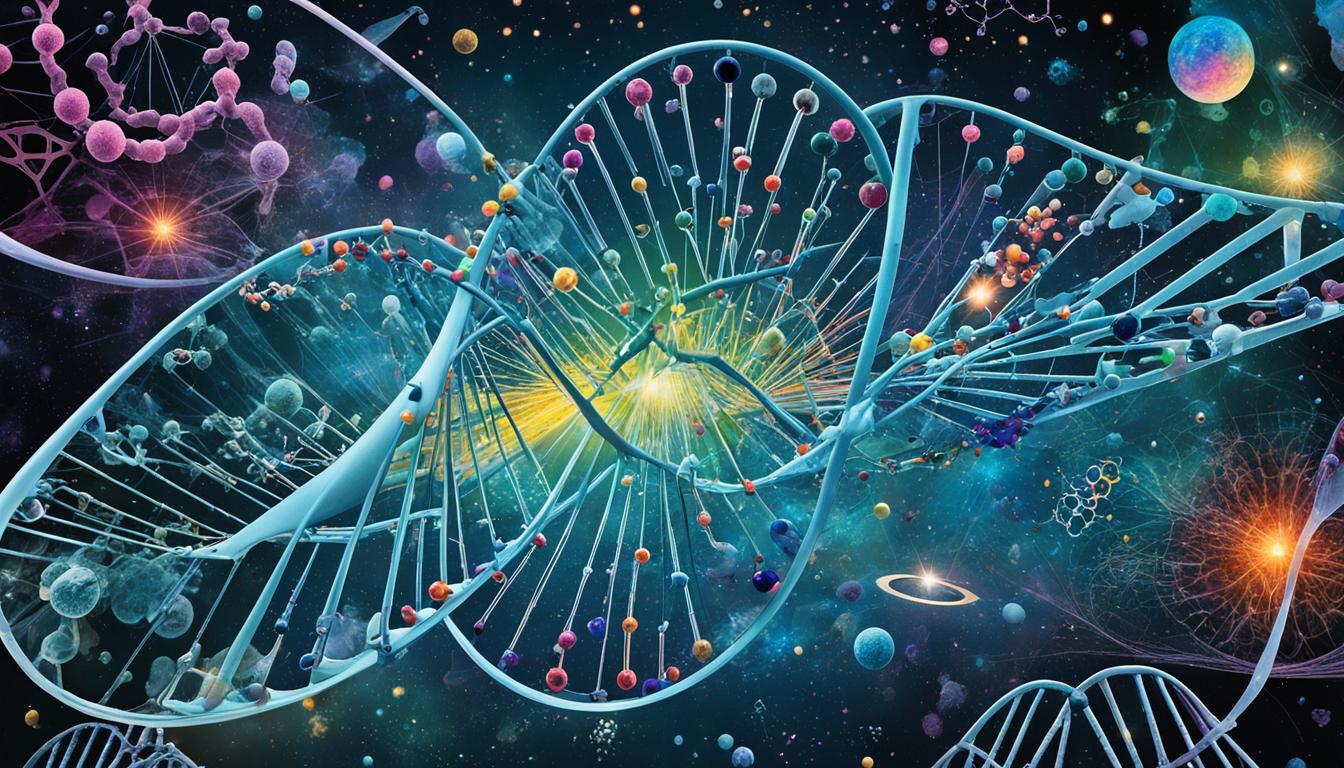
James Watson and Francis Crick discovered the DNA molecule and its double-helix structure in the 1950s. This was a major breakthrough in biology. It revealed how life passes on traits from one generation to the next.
This discovery changed fields like molecular biology, genetics, and medicine. It led to new ways in genetic engineering, disease diagnosis, and personalized healthcare.
The discovery of DNA changed how we understand life. Scientists learned how genes shape traits in all living things, from tiny microbes to complex humans. This knowledge has opened new areas in genetic research.
It lets researchers study the genetic roots of traits, diseases, and how species evolve. This has been a game-changer.
Understanding DNA’s structure has also changed molecular biology. Scientists can now study how genes work, how DNA makes copies, and how proteins are made. This has led to big advances in genetic engineering.
Scientists can now create new crops, fight diseases, and explore regenerative medicine. The discovery of DNA has truly changed the game in genetic research.
It has opened up new ways to understand life and tackle big challenges. As we keep exploring the genetic code, the future looks bright. DNA holds great promise for solving humanity’s biggest problems.
The Big Bang Theory: Unraveling the Origins of the Universe
The Big Bang theory is a key scientific idea that explains how our universe began and changed over time. Belgian physicist Georges Lemaître first suggested it in the 1920s. This theory has grown stronger with lots of scientific proof, changing how we see the universe.
At its core, the Big Bang theory says the universe started from a super-hot, super-dense state. It then expanded and cooled over billions of years to become the vast, complex place we see today.
Cosmic Microwave Background Radiation
The cosmic microwave background (CMB) radiation is strong proof for the Big Bang theory. This ancient light goes back to the universe’s early days. It fills the universe and is a leftover from the Big Bang.
Arno Penzias and Robert Wilson found the CMB in 1964. This discovery was a big deal, showing us what the universe was like in its early days. It also backed up the Big Bang theory’s main ideas.
Expanding Universe and Dark Matter
More proof for the Big Bang comes from how the universe is always getting bigger. Edwin Hubble discovered this in the 1920s. Since then, scientists have learned more about the universe’s expansion.
They found that dark matter and dark energy make the universe expand. Studying these mysterious forces helps us understand the universe better. It also gives us new insights into the Big Bang and the universe’s beginnings.
Vaccination: A Breakthrough in Disease Prevention
Vaccines have changed the game in public health, saving countless lives. They protect against diseases like smallpox, polio, measles, and COVID-19. Scientists like Edward Jenner and Louis Pasteur led the way, making vaccines a key tool against infectious diseases.
Historical Milestones in Vaccine Development
The story of vaccines is full of innovation and hard work. Edward Jenner discovered the smallpox vaccine in the late 1700s, starting a new chapter in medicine. Louis Pasteur later made big strides with the rabies vaccine, deepening our understanding of immunity.
Since then, vaccine technology has grown by leaps and bounds. From the first smallpox vaccine to today’s mRNA vaccines, we’ve seen huge progress. Vaccines like the MMR vaccine have made a big impact, protecting against several diseases at once.
Now, vaccines are seen as a key public health tool, saving millions of lives yearly. With ongoing research, we’re on track for even more advances. This could lead to the end of many infectious diseases, improving health worldwide.

The Periodic Table: Organizing the Building Blocks of Matter
The periodic table is key in chemistry, sorting elements by their atomic traits and how they react. Dmitri Mendeleev, a Russian chemist, created it in the 19th century. This changed how we see matter and its basic parts.
Mendeleev’s Groundbreaking Framework
Mendeleev’s work was a big step forward. He predicted the existence and traits of elements not yet found. By sorting elements by atomic weight and chemical traits, he made a system that showed patterns and trends.
Over time, the table has changed with new discoveries and better understanding of atoms and chemistry. Yet, Mendeleev’s original work is still the base of this important tool. It helps with research in chemistry, physics, and material science.
Amazing Discoveries in Evolutionary Biology
Charles Darwin changed the game in evolutionary biology with his theory of natural selection. His work, “On the Origin of Species,” explained how life on Earth became so diverse. It showed us the ways species evolve.
Darwin’s Theory of Natural Selection
Darwin said that every species has variations in looks and behavior. These differences help some individuals survive and have more babies. Over time, the traits that help survive spread, leading to new species and changes in existing ones.
This idea of natural selection changed how we see the world. It guides research in many areas like genetics and ecology. Scientists keep learning about how species change and how life on Earth began.
Darwin’s work changed our view of nature. The ideas of evolutionary biology help us understand life’s origins and how it has changed over time.
The Transistor: Ushering in the Digital Age
In 1947, John Bardeen, Walter Brattain, and William Shockley invented the transistor. This was a key moment that started the digital revolution. The transistor could amplify, switch, and control electrical signals. It helped create integrated circuits, microprocessors, and made digital technology widespread.
The transistor made it possible to shrink electronic devices and boost computing power. It changed the world by revolutionizing industries, communication, and daily life. It turned the world into a digitally connected place. This small semiconductor has led to the creation of many electronic devices, like personal computers and smartphones, that are key to our lives today.
The transistor’s effect on electronics and digital tech is huge. It let us make smaller electronic parts. This led to the creation of integrated circuits and microprocessors. These have greatly increased computing power and efficiency.
This has made digital technology more common. It changed how we talk, work, and live. The transistor’s impact is still felt today and will shape the future of electronics and digital systems.
The transistor and its offshoots, like integrated circuits and microprocessors, will keep playing a big part in the digital world ahead.
Plate Tectonics: Understanding the Dynamic Earth
The theory of plate tectonics has changed how we see the Earth’s surface and its processes. It combines ideas like continental drift and seafloor spreading. This theory explains how mountains, volcanoes, and earthquakes form.
Continental Drift and Seafloor Spreading
In the early 1900s, scientists thought the Earth’s landmasses moved over time. This idea grew stronger with the discovery of seafloor spreading. New oceanic crust forms at the edges of tectonic plates.
The plate tectonics theory links these ideas. It shows how the Earth’s surface plates moving and interacting cause geological changes.

The plate tectonics model has changed our view of the Earth’s inside and its geological processes. By studying tectonic plates, scientists have learned a lot about the Earth’s history. They understand how the land and oceans formed and why earthquakes and volcanoes happen.
The Discovery of Penicillin: A Revolution in Antibiotics
Alexander Fleming discovered penicillin in 1928, changing medicine forever. His find with the Penicillium fungus led to the first effective antibiotic. This started a new era in fighting bacterial infections.
Fleming’s Accidental Breakthrough
Fleming was working at St. Mary’s Hospital in London when he saw something amazing. A mold had contaminated a Petri dish with Staphylococcus bacteria. But, the mold had created a circle where no bacteria could be found.
This led him to study the mold further. He found it was Penicillium fungus. This fungus made a substance that could kill harmful bacteria. Fleming named this substance penicillin.
Penicillin was a huge breakthrough. It could kill many harmful bacteria, saving lives. During World War II, it helped save countless people. This led to the creation of more antibiotics, changing medicine forever.
But, bacteria are now becoming resistant to antibiotics. This means we need new treatments. Fleming’s discovery of penicillin shows how important scientific discoveries are. It also highlights the need for ongoing research in medicine.
The Human Genome Project: Mapping Our Genetic Blueprint
The human genome is a set of genetic instructions that define who we are. In the late 20th century, scientists started the Human Genome Project. This project aimed to understand our genetic code. It took over a decade to complete and was a major breakthrough in genetics and molecular biology.
By mapping the human genome, the project gave us a deep look into our genetic makeup. This discovery has led to new areas in personalized medicine and genetic engineering. It has also changed how we understand human biology.
Now, we can diagnose diseases more accurately and create treatments that fit each person’s genes. This has changed how we approach medicine.
Sequencing the human genome has changed biotechnology and genomics a lot. Researchers can now find genetic variants linked to diseases. This has led to better diagnostic tools and new treatments.
The Human Genome Project has done more than just advance science. It has helped us understand human evolution and genetic diversity. This knowledge is driving new research and helping scientists and doctors improve health care.
Quantum Mechanics: Unveiling the Mysteries of the Subatomic World
In the early 1900s, quantum mechanics changed how we see matter and energy at the smallest scales. This new field showed us the strange world of the quantum, where old physics rules don’t work.
Wave-Particle Duality and Uncertainty Principle
Quantum mechanics teaches us that things can be both waves and particles at the same time. This idea, called wave-particle duality, shows us that electrons and other tiny particles can act like waves or particles. This idea changes how we think about the tiny world.
The Heisenberg uncertainty principle is another key idea in quantum mechanics. It says we can’t know both where a particle is and how fast it’s moving at the same time. This shows us that the tiny world is full of uncertainty and chance.
Quantum mechanics has greatly influenced modern physics. It has led to big advances in fields like particle physics, nanotechnology, and information technology. Thanks to quantum mechanics, we have quantum computing and cryptography, and we’re learning more about the universe’s basic building blocks.
The Discovery of Stem Cells: Unlocking Regenerative Medicine
The study of stem cells has changed regenerative medicine a lot. These cells can turn into many different cell types. This has opened new ways to fix damaged tissues and organs.
Scientists are using stem cells to find new treatments for spinal cord injuries, diabetes, and other diseases. They see stem cells as a way to make new tissues and personalized treatments. This is changing how we think about treating many health problems.
As we learn more about stem cells, the possibilities for regenerative medicine grow. These discoveries could help our bodies heal better. They could change how we treat many illnesses and injuries in the future.